
Read Washington County Property Tax Records
Washington County splits value work from billing work. The Board of Tax Assessors sets taxability and fair-market value, handles equalization and exemptions, and takes the first look at appeals. The Tax Commissioner then receives the roll, mails the bills, collects payment, and distributes the revenue.
| Field | What It Shows | Where |
|---|---|---|
| Fair-market value | January 1 value set for the annual digest | Board of Tax Assessors |
| Assessed value | Generally 40% of fair-market value | Board of Tax Assessors |
| Exemptions | Approved reductions tied to the parcel and applicant | Board of Tax Assessors |
| Tax bill | The charge produced from taxable value and millage | Tax Commissioner |
| Payment or delinquency file | Collection status held by the billing office | Tax Commissioner |
A mill equals one dollar of tax for each $1,000 of assessed value. Exemptions can lower taxable value, so fair-market, assessed, taxable, billed, and recorded sale figures are not one and the same number.
Find a Washington County Tax Bill
The county points taxpayers to GovernmentWindow for payment and asks for the tax bill number. No claim is made here about address search, payment history, receipts, or balance fields on that form.
- Use QPublic or GIS to match the address and save the parcel ID.
- Find the bill number on the current notice or ask the Tax Commissioner.
- Open the county payment landing and choose Property Tax.
- Compare the bill with the assessor value and exemption record.
- Ask the office directly about any missing payment, delinquency, or tax-sale status.
- Assessed value
- The general 40% share of fair-market value before applicable exemptions.
- Millage
- Tax of one dollar per $1,000 of assessed value.
- Homestead exemption
- Relief tied to a qualifying owner-occupied legal residence.
- Tax lien
- A recorded claim connected to unpaid tax, which must be read with any release.
Washington County Values Start January 1
The local QPublic information states that fair-market value is set as of January 1 each year. Property tax returns run from January 1 through April 1. A return can report added property, new improvements, or another change and may preserve appeal rights.
The Washington assessment information page shows these local rules.
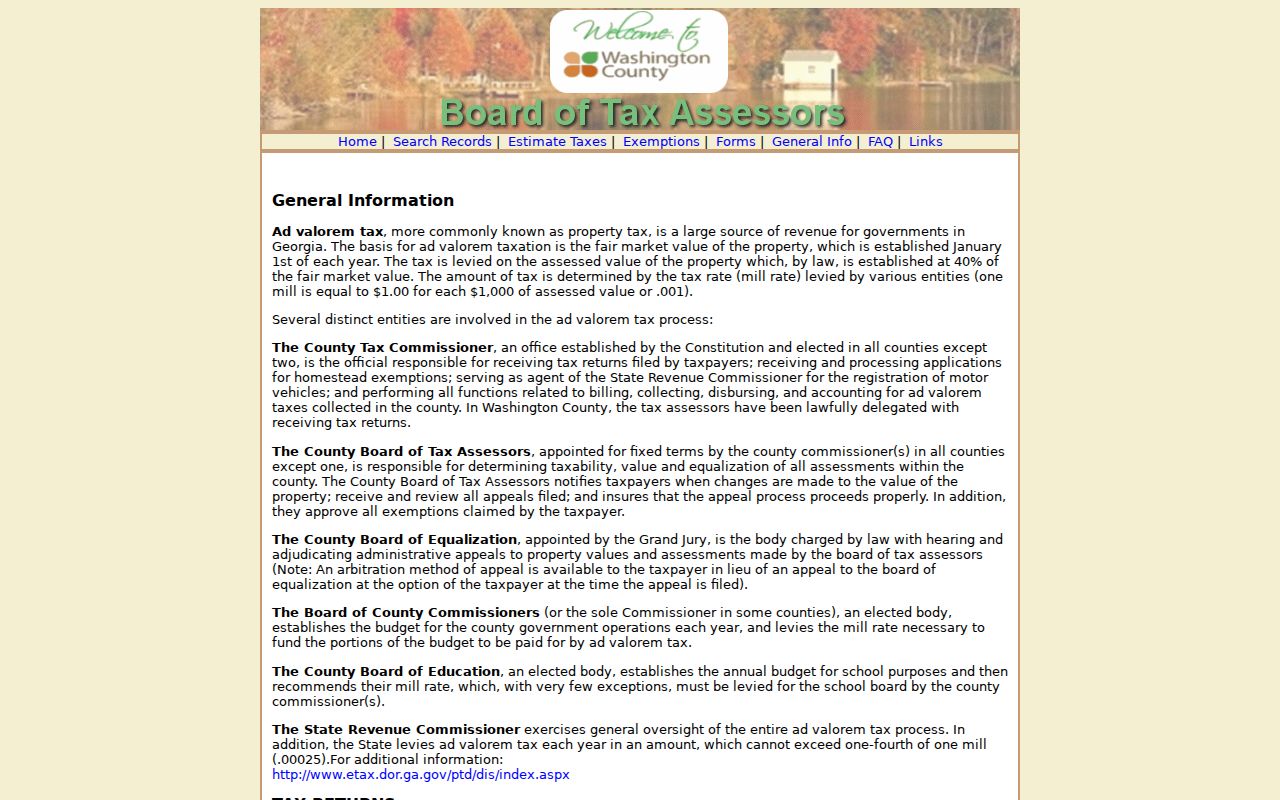
The assessment page lays out the framework for values on the tax roll. Tax bills themselves stay with the Tax Commissioner.
Apply Washington County Exemptions
The local exemption page covers standard homestead, age-based relief, disabled-veteran and surviving-spouse provisions. It also covers conservation use and Freeport. A first homestead filing runs January 1 through April 1. It renews automatically once granted. An ownership, name, or vesting change calls for a new filing.
The Tax Commissioner also advertises a local $10,000 exemption. It applies to qualified residents age 65 and older. Other local material carries older state and county figures. Date-check the current form rather than combining amounts. Conservation Use generally works with a 30% level for qualifying land. It carries a ten-year covenant, an April 1 deadline, and a listed $10 recording fee.
Check Washington Tax-Sale Clues
Official Sandersville tax-sale notices pack in detail. One notice may tie together the map parcel, the current record holder, the defendant in fi-fa, the tax years, the deed book, street address, lot, subdivision, and legal description. Treat it as a lead. A notice proves neither present ownership nor current delinquency.
Washington County publishes no searchable countywide sale database. Ask the Tax Commissioner for sale lists, redemption records, and excess-funds documents by parcel and year. The Clerk's deed records may hold a recorded tax-sale deed or a redemption reference.
Calculate Washington County Property Tax Context
Georgia assesses taxable property at 40 percent of fair-market value. The local general-information page frames the estimate simply. Take fair-market value, multiply by 40 percent, subtract exemptions, then apply the millage rate. A mill is one dollar per $1,000 assessed.
Keep the values apart. Fair-market, assessed, exempted, taxable, and billed amounts are related, but they are not interchangeable.
Millage can come from the county, the school district, and the municipality covering the parcel. A mailing address can mislead. Match rates and exemptions to one year and jurisdiction. Never apply a city rate just because the mailing address carries that city's name.
Separate Washington County Tax Offices
The Board of Tax Assessors appraises property, maintains the assessment roll, reviews tax returns, and takes exemption and assessment questions. The Tax Commissioner bills, collects, and distributes property taxes. A valuation challenge sent to the collections office can delay the real task.
| Record or issue | Office | Best reference to provide |
|---|---|---|
| Parcel value or taxability | Board of Tax Assessors | Parcel ID, tax year, and assessment notice |
| Homestead or current-use filing | Board of Tax Assessors | Parcel ID, ownership date, and application |
| Bill number or payment status | Tax Commissioner | Bill number, parcel, taxpayer name, and year |
| Delinquency or excess-funds file | Tax Commissioner | Parcel, sale year, and existing record sought |
| Recorded tax-sale deed | Clerk of Superior Court | Party, date, deed book, or instrument reference |
QPublic supplies the official assessment route. GovernmentWindow supplies the county's payment route, but the property-tax form sits behind a captcha.
Request Washington County Tax Records Offline
When an online parcel card or tax bill will not open, go to the office that keeps the record. The Board of Tax Assessors lists PO Box 308 in Sandersville, phone 478-552-2937, and wboa@washingtoncountyga.gov. The Tax Commissioner sits at 115 Jones Street, PO Box 469, and answers at 478-552-2144 on weekdays from 9 a.m. to 4:45 p.m.
Ask for a specific parcel card, assessment notice, tax bill, payment record, exemption record, delinquency file, or sale list, and name the parcel number and year. The Georgia Open Records Act gives a custodian three business days to produce a record or explain the timing, cost, or a statutory reason for withholding it. Search, retrieval, redaction, and copying charges may apply.
Keep the request narrow. A demand for everything tied to an address is harder to process. State the format wanted, and ask for a cost estimate before any broad work begins.
Reconcile the Washington County Tax-Roll Owner
The annual assessment roll and a freshly recorded deed often capture different moments in time. A name on the tax roll can lag behind the deed. The taxpayer or owner of record may look stale. Jot down the parcel number and the legal description. Then check the latest grantee entry in the Clerk's deed index. Keep in mind that a tax mailing address may point to an agent. It may also point to an owner living elsewhere. It is not the parcel situs. Treat the dated roll name as proof of only what it actually proves.
A party in the deed index deserves a closer look, too. That same name might be a lender, grantor, trustee, or easement holder. It may not be the current owner at all. Match the instrument type, the party's role, and the land description. Your Washington County property tax search stays anchored to the right tract.
Appeal a Washington County Assessment
Georgia handles assessment appeals under O.C.G.A. §48-5-311. Follow the route and deadline printed on your current assessment-change notice. The Board of Tax Assessors reviews each filing. The Board of Equalization can hear appeals that move forward. Build your case around the parcel number. Add the notice, comparable official records, photos, and dated facts about the land or its improvements.
One caution on timing. A 2024 local notice reported an extra 180 days under one statutory provision. But that was a dated event rather than a lasting Washington County rule. Confirm current deadlines with the assessor office or the notice itself.
Appeal window. File by the deadline on the current Washington County notice; do not reuse the unusual 2024 extension as a standing rule.