
Trace Back Washington County Former Owners
Begin with the newest vesting deed and prove each step back. One transfer at a time. The county publishes no volume-by-volume chronology of former owners, so plan on a holdings check at the office or an archive rather than assuming coverage.
| Former-owner source | Verified span | Access point | Use in the chain |
|---|---|---|---|
| GSCCCA deed index | January 1, 1987 forward | Online or Clerk terminal | Grantors, grantees, dates, and deed keys |
| Older deed books and microfilm | Exact run not verified | Clerk and Georgia Archives | Pre-1987 transfers |
| Historic plats and maps | Exact run not verified | Clerk, Archives, Genealogy Center | Lots, subdivisions, districts, and land lots |
| Estate papers and newspapers | Estate papers 1829-1903; newspapers 1852-2009 | Old Jail Genealogy Center | Name, date, executor, and place clues |
Start with the GSCCCA index for the modern chain. When the next earlier deed falls outside online coverage, carry the last reliable book and page, plus the legal description, into the offline records.
Search Washington County Prior Owner Roles
The GSCCCA real-estate index lets you search by Grantor, Grantee, or Both, with room for a person or an organization, instrument type, county, and date limits. Run a known former owner as grantee first. That finds the acquisition. Then run it as grantor for the later transfer. Copy initials, punctuation, and entity suffixes exactly, since a same-name hit is only a lead until the parcel description, date, and deed reference all match.
The GSCCCA party-search screen displays role and name controls.
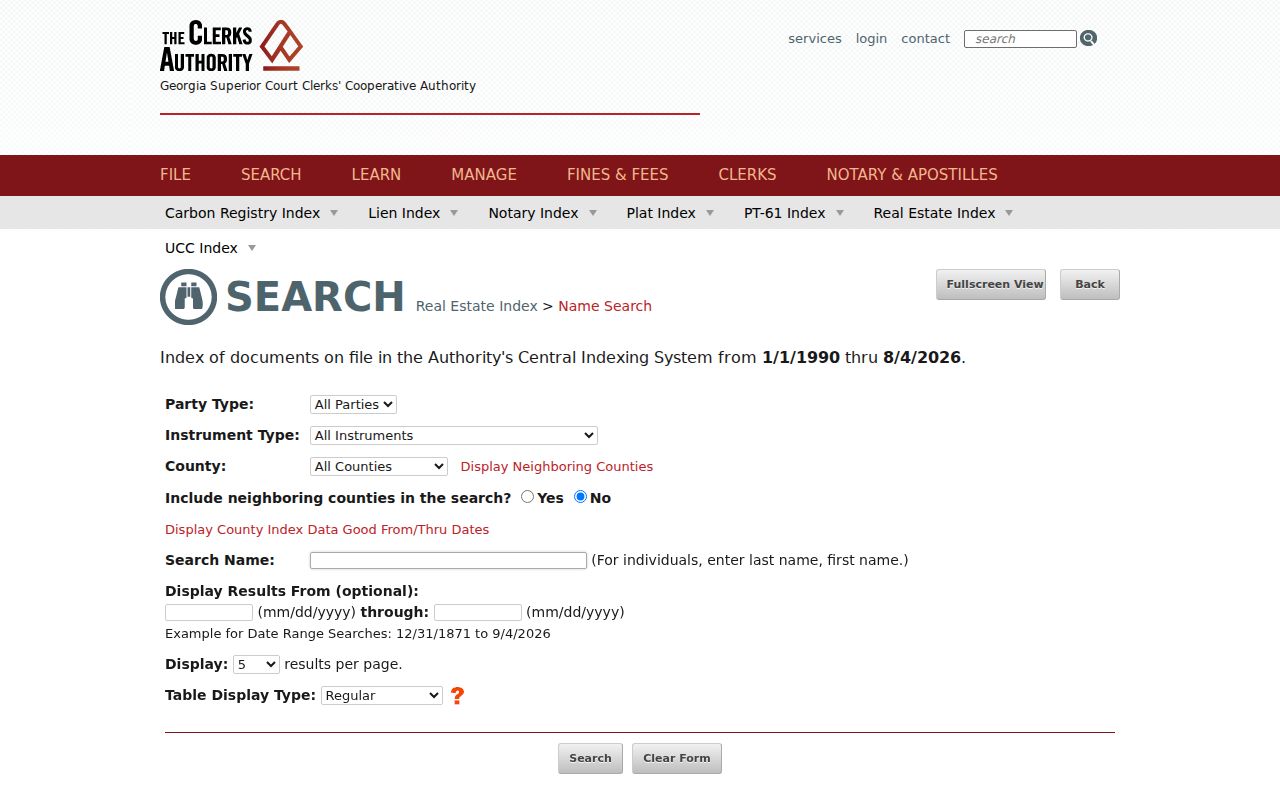
Role, county, and date limits come first. Set them before tying any result to a prior owner of record.
Reconstruct Washington County's Deed Chain
Each loop starts with one confirmed deed. The goal is proving that successive instruments concern the same tract, not collecting every record for a surname.
- Find the current vesting deed and copy its grantor, grantee, date, book/page or instrument number, and land description.
- Search its grantor as an earlier grantee within a sensible date range.
- Match lot, subdivision, land lot, district, acreage, roads, creeks, or adjoining-owner clues.
- Repeat to 1987, then take the last citation to the Clerk, Archives, or Genealogy Center.
- Grantor
- The party conveying the stated interest.
- Grantee
- The party receiving that interest.
- Chain of title
- The linked sequence of recorded interests in the same land.
- Legal description
- The deed language that follows land when a street label changes.
Match Washington County Ownership Cross-Keys
Book and page citations bridge one deed to the next. Plats add lot, subdivision, district, land lot, section, and clerk-file clues. Rural descriptions may lean on old roads, creeks, adjoining owners, or metes and bounds. The deed proves the conveyance itself. The plat shows the chain stayed on one tract. A parcel split or combination can break a tidy line, so record the parent tract and each new legal description rather than forcing one modern parcel ID onto older deeds.
Explain Washington County Special Transfers
An estate, sheriff's deed, foreclosure, quitclaim, or tax sale can interrupt a simple sale-to-sale sequence. GSCCCA identifies administrator, executor, guardian, foreclosure, sheriff, tax, quitclaim, and warranty deed categories. Use probate, court, lien, or tax records to explain authority, then return to the recorded land instrument.
Sandersville tax-sale notices can combine record holder, defendant in fi-fa, deed book, map/parcel, lot, subdivision, street, and legal description. These details are strong search keys, but the notice does not replace the deed.
Assess Washington County Record Loss
County sources describe courthouse and public-building destruction during the 1864 campaign. A tourism history says Sherman's forces burned one courthouse. The 1869 brick courthouse stands on that foundation. The county publishes no list of which deed books survived, were reconstructed, or were microfilmed. That gap calls for a holdings check. Ask the Clerk and the Georgia Archives for the specific volume or reel sequence tied to the last known deed.
Follow Washington County Former Owner Names
The 1891 Old Jail at 129 Jones Street now houses the Washington County Genealogy Research Center. Its brochure lists more than 13,000 index cards for more than 9,000 people. Estate Papers run from 1829 through 1903. Marriage books A-M span 1828 through 1938. Maps, land records, cemetery material, and newspapers wait there. Digital newspapers spanning 1852 through 2009 add obituaries, estate notices, tax sales, plat dedications, and former road terms that can anchor a prior owner to a time and place. Confirm each link in the land record.
The Genealogy Research Center says researchers are on hand. Its published schedule lists Tuesday by appointment, Thursday and Friday afternoons, and Saturday hours. Check hours before any visit. A focused request naming the former owner, deed date, tract, and suspected community gives staff a far better start than a broad surname sweep. Old place words matter in Washington County. Warthen, Deepstep, Oconee, Riddleville, Harrison, Davisboro, Sandersville, and Tennille, plus railroad stations, mills, and kaolin references, may stand where a modern searcher expects a street address. Keep the old wording. Test those variants in maps, newspapers, and later deeds. A historical place match narrows the search. Only the recorded chain establishes the true sequence of previous owners.
Extend Washington County Ownership Offline
The Clerk of Superior Court sits at 132 W Haynes Street with a public computer terminal. Doors open weekdays, 9:00 a.m. to 5:00 p.m. Call 478-552-3186 with questions. Mail PO Box 231, Sandersville, GA 31082, and give the parties, date range, last book and page, and legal description rather than asking for everything under a common surname.
State the limit. If the older chain cannot be completed, identify the last confirmed deed and missing span. Do not invent a former owner from a tax roll, map, or newspaper clue.
Georgia Open Records Act requests offer another route to identifiable public records. No office must build a chain analysis for you. Former-owner research supports house history, estate work, and purchase diligence. It must never track or harass a living person.